


There are songs you choose because of what they mean to you, and others that get your guests out of their seats. The wedding music needs to make room for both.
You don’t need to turn up with a perfect playlist. It’s more helpful to know what moves you, what you don’t want to hear, and where you’d like to give the DJ free rein. Then it’s a case of organising the setlist, coordinating the timing and making sure everything flows smoothly, even when the schedule changes.
That’s how we do things at Aleea, from the very first conversation right through to the very last song.
Table of contents
We’ll start by getting to know you, not by asking you for a hundred songs
We usually hold a meeting to discuss the venue, your guests and how you envisage the celebration. A few example songs, the styles you like and some examples of what you’d prefer to avoid help us understand you better than a very long list without any context.
We also go through the venues and moments you’d like to cover. Using these details, we put together a musical concept and share some examples to make sure we’re both picturing the same atmosphere.
Four lists that are a great help to us
- What you’d actually like to hear. Memorable songs, shared memories and tracks that get you dancing. Let us know which ones have a special place in your hearts.
- What you don’t want to be heard. Songs, artists or genres that you’d prefer to exclude. A clear request to exclude something will be respected, even if a guest asks for it.
- What you would accept on behalf of your people. Music you wouldn’t choose to listen to at home, but which you’re happy to share whilst out at a party. We can discuss how much and in what context.
- How would you like to handle the requests?. Whether they are accepted and, if so, within what limits. The DJ must be able to decide when they are appropriate, always within the terms agreed with you.
There’s an important difference between “I’m not keen on it” and “I don’t want it to be played”. It gives you the flexibility to be considerate of your guests without compromising your own tastes. Ideally, you should both take part in this discussion.
Meaningful songs have a message
Next, we draw up the script: what’s going to happen, which track should play and who will let everyone know when everything’s ready. We coordinate this with the venue, the wedding planner (if there is one) and everyone involved. That way, you won’t have to spend the wedding worrying about the microphone or the next entrance.
A surprise can still be a surprise for you, whilst being organised in advance by those who need to put it into action. All it takes is for the person organising it to make the necessary arrangements in advance.
Your day, moment by moment
This table serves as a starting point. Not all weddings include every stage, nor do they have to follow the same order: adapt it to your ceremony and your own way of celebrating.
| Moment | What music is all about | What to decide |
|---|---|---|
| Arrival of guests | Making people feel welcome and creating a good atmosphere | Style, volume and flexible duration |
| Tickets for the ceremony | Make each post stand out | Order, version, starting point and signal |
| Readings, vows and rings | Be there when it makes sense to do so | Whether there will be a background sound or silence, and how the voices will be heard |
| A kiss and off we go | Celebrating a new beginning | Exact signal, fragment and continuity |
| Cocktail | To facilitate conversation and interaction | DJ set, musicians and plenty of energy |
| Entrance to the banquet | Welcoming you with a touch of personality | Song, route and coordination with the control room |
| Food, speeches and toasts | Supporting without competing | Microphones, pauses and those in charge |
| Dedications, a cake or other gestures | Highlight selected moments | What do you actually do, and which song goes with it? |
| First dance | Create your own moment | Version, duration, ending and guest appearances |
| Party and ‘crazy hour’ | Staying connected and energised | Preferences, limits, requests and possible interventions |
| Last song | Close with purpose | Final topic, timetable and organisation of the trip |
The ceremony: when to offer support and when to remain silent
The arrival of the guests
The atmosphere of the ceremony begins to take hold as people take their seats. A gentle selection of music can create a warm welcome without yet demanding everyone’s full attention. It is a good idea to have more music to hand than is strictly necessary, so that a short wait does not mean having to repeat the same track.
The volume should be high enough to allow people to greet one another and hear the instructions. If the ceremony is outdoors, the sound layout and microphones deserve just as much attention as the music: guests at the back should also be able to follow what is happening.
Your tickets
You can enter separately, together, with family members or in your own way. For each entry, choose the exact part of the track and think about where you want its most exciting bit to come in. It’s not the same to start from the very second as it is to jump straight into a chorus or an instrumental section.
Allow plenty of time for the walk. A song shouldn’t force you to walk quickly, and a short corridor might mean you miss your favourite bit if you haven’t prepared for it. The agreed person will give the starting signal when everything is ready, not just because the clock says it’s time.
Readings, vows and the exchange of rings
There’s no need to fill every moment of silence with music. During important speeches, the voice alone may be enough. If you want background music, it must be planned in advance and ensure the speech remains the clear focus. Check with the person officiating to agree which parts will have music and which will not.
For ceremonies with a specific format or protocol, check with the venue manager to see what options are available. The songs should reflect the spirit of the occasion and fit in with its actual timing.
The kiss and the end of the ceremony
A kiss is one of those moments when the right musical cue can make all the difference. It’s a good idea to agree on whether the song should start after the officiant has spoken, at the moment of the kiss, or after the first round of applause. That way, we avoid drowning out the line that everyone wants to hear.
The exit can continue with that song or feature its own, more celebratory track. Confirm when you’ll start walking and whether there’ll be a short break for photos, hugs or any other planned gestures. The music should accompany your actual exit, even if it takes a few seconds longer than expected.
A cocktail with character, whilst still allowing for conversation
A cocktail party usually involves greetings, photos and groups of people who know one another. Music can set the mood without requiring everyone to dance. Depending on your tastes, we can choose from soul, funk, jazz, covers, Mediterranean sounds, pop or soft electronic music, amongst other genres.
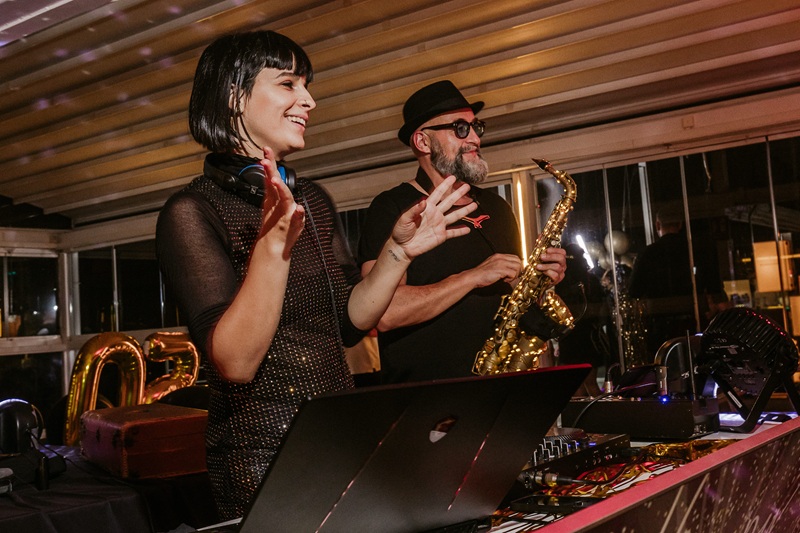
One option we’re working on at Aleea is to combine DJ with a guitarist, saxophonist, singer or percussionist. The session maintains a sense of continuity, and the live performances add a sense of presence, nuance and moments that capture the audience’s attention. You don’t need to turn the whole cocktail party into a concert to enjoy the musicians.
The DJ and saxophone It can accompany an elegant selection or gradually build up the energy. A guitar or a voice can give it a different feel; percussion can add rhythm. The choice depends on the repertoire, the venue and the atmosphere you wish to create.
Before finalising the format, we sort out the transitions, the breaks, the suitable repertoire and the sound requirements. We also need to plan for continuity when a musician takes a break and what happens if the cocktail party runs over time. Coordination ensures that the ensemble sounds like a cohesive whole.

The banquet has its own rhythm too
The entrance to the reception can be exciting, fun or simply festive. Choose a song that lets you make your entrance just as you’d like, and time it to suit the venue: we don’t want to start your big moment whilst some of the guests are still outside or the staff are waiting for instructions.
During the meal, the atmosphere changes. The music should complement the conversations, with a volume and energy level suited to the occasion. If you want a few brief bursts of louder music, decide which ones really add something: constantly interrupting the conversation can detract from the moments that really matter to you.
For speeches and toasts, make sure the microphones are ready and arrange a signal to turn down or stop the music. Confirm the names of those who will be speaking and who will give them the cue. If a video is to be shown, check the audio in advance: you don’t want to find out during the wedding that the sound is only coming from the laptop.
Gifts, dedications, the cake and the throwing of the bouquet are optional. If you do decide to include them, assign a song and a cue to each one. If they don’t reflect who you are, you don’t need to include them just to complete a traditional list. You could also include a subtle dedication or a family memento without turning it into a public announcement.
From the first dance to a shared dance floor
For your first dance, choose a song that makes you feel comfortable. It could be a slow song, an upbeat one, a remixed version or a short dance track. The important thing is to be clear about the version and the length: a radio edit, a live version and an acoustic recording can all have very different structures.
If you’ve rehearsed a routine, please share the exact audio track you used. Please specify how it begins, where it ends and whether there’s a planned cut. Please also confirm whether you’ll be dancing on your own until the end or whether family and friends will join in at a specific point.
The next song calls for a decision. You could invite everyone to join in, or kick off the first set with a track designed to bring different age groups together. That transition helps ensure the first dance leads straight into a party, rather than ending in a moment of uncertainty about what to do next.
Different tastes, the same party
At a wedding, there are people who might never share a playlist. The DJ’s role is to find common ground between them and maintain the atmosphere throughout the celebration. It’s not about every guest loving every song, but about providing opportunities to get involved and making different groups feel included.
To achieve this, observation and structure are key. A classic track can set the tone; a recognisable transition can bridge two styles; a section that is too long can cause those taking part to lose focus. The audience’s actual reaction helps to decide when to continue in a particular direction and when to change course.
Also mention languages, backgrounds and cultural preferences where relevant. Age provides a guide, but does not define tastes: there may be older relatives who want electronic music and younger friends who are looking forward to songs from another decade. Specific references are usually more helpful than general labels.
Your must-haves and no-gos continue to guide the set. Within that framework, leaving some leeway allows the DJ to choose the right moment for everything. Planning every minute of the open bar before knowing how the dance floor will respond may actually make it harder to adapt – which is precisely what you’re paying for.

«Can you put a song on for me?»
Song requests can bring back memories and bring a group together, but it’s worth deciding how they’ll be handled. You could choose not to accept any, allow them at the DJ’s discretion, or set aside a few requests in advance of the wedding. The key is to make sure the rule is clear.
If you accept them, we recommend that you consider three things: whether they stick to what was agreed with you, whether they fit in with the atmosphere of the moment, and whether they contribute to the party as a whole. Requesting a song doesn’t mean it has to be played straight away. It might work better later on, or it might not be suitable for that particular celebration.
For example, a very sentimental ballad might be perfect for a dedication and could bring a dance floor that’s really getting going to a sudden halt. A song on your ‘banned’ list shouldn’t be played just because someone close to you requests it. And one person’s insistence shouldn’t dictate the music for everyone else.
You could also agree that certain requests should only be discussed with one designated contact person. This saves you from having to approve songs during the wedding and allows the DJ to handle the requests smoothly.
The ‘crazy hour’ and a send-off your way
The ‘crazy hour’ is an option for creating a burst of energy with music, props, entertainment or musicians, depending on the package you book. It doesn’t need to last exactly one hour, nor does it have to take place at the same time at every wedding. The timing should fit in with the flow of the party.
If there are to be percussion, saxophone or other musical contributions, please coordinate the timing of the entries and the duration of the performances. If anyone is planning a surprise, they must speak to the music coordinator in advance and explain what they need. Keeping it a secret does not mean improvising connections, audio or signals in front of everyone.
The closing moments also deserve some thought. You can choose a final song to sing together, a heartfelt farewell or an energetic finale. It’s a good idea to coordinate this with the venue’s timetable and the guests’ departure, so that the ending feels well-planned rather than like an abrupt cut-off.
Some questions that often come up
Do we have to choose all the songs?
No. Choose the tracks for the key moments, share your must-haves and make your limits clear. The DJ can take care of the rest, leaving room to adapt to the guests.
What if our tastes are very different from those of the family?
Separate what you don’t want to hear from what you might be open to at some point. With these points in mind, you can look for connections and switch between styles without turning the party into something that doesn’t reflect who you are.
Does a guest’s request have to be played?
Not necessarily. First, he must stick to what was agreed with you. Then the DJ assesses whether a track fits the atmosphere and when it might work; accepting requests doesn’t mean playing them straight away.
Can we have both a DJ and musicians at the cocktail party?
Yes. At Aleea, we feature a guitarist, a saxophonist, a singer and a percussionist. The line-up is tailored to the style, the venue, the set times and the sound requirements.
What happens if the banquet is delayed?
The script is adapted and the change is co-ordinated with the control room. For major scenes, a signal indicating that everything is ready is more useful than sticking to a time that no longer corresponds to what is actually happening.