


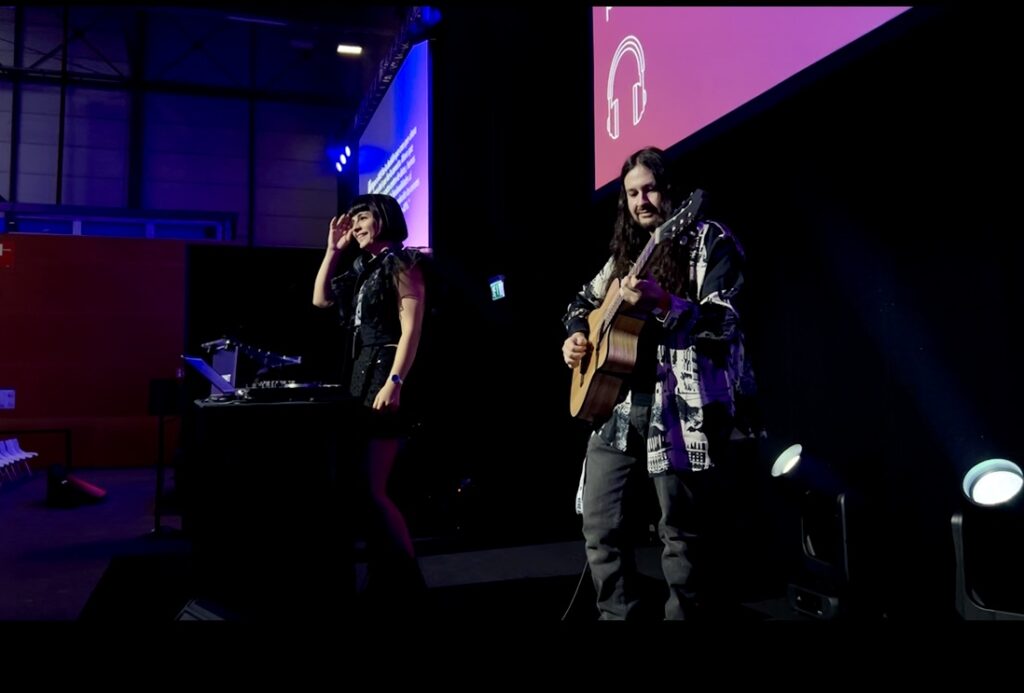
You like the flow of a DJ set, but you want something extra to happen at some point: a guitar coming in over the mix, a saxophone bringing the melody closer to the guests, or a voice that turns a familiar song into a performance. Combining a DJ with live musicians can give your event that special touch.
The choice doesn’t start with deciding which instrument is most fashionable. It starts with the atmosphere you want to create: providing background music for conversations at a cocktail party, adding a special touch to a reception, kicking off a party, or creating a moment for quiet listening during a celebration.
Guitar, saxophone and vocals each offer different possibilities. Let’s see how to choose between them and what the line-up needs to sound and work as a cohesive performance.
Table of contents
A collaborative performance, with each moment taking centre stage as required
The DJ keeps the set flowing, whilst the musician provides a live performance. For the combination to work, both need to agree on styles, repertoire, entry points and the length of their contributions. It’s not simply a matter of adding an instrument to any song without any preparation.
There may be live performances interspersed with DJ sets, performances focusing on specific pieces, or a highlight moment. This structure is decided according to the event and must be set out in the proposal.
More playing time does not necessarily mean a better experience. A well-timed performance can liven up the party and then leave room for conversation. At a party, alternating between live music and a DJ set allows you to create changes in atmosphere without requiring the musician to play all night.
Guitar, saxophone or vocals: what each format can bring
These aren’t fixed categories. The set list, the performance and the rapport with the DJ can greatly affect the outcome. Even so, this comparison helps you to visualise what you’re imagining and to listen to examples with a specific aim in mind.
| Format | You can contribute | Before choosing |
|---|---|---|
| DJ + guitar | Intimacy, acoustic texture or rhythmic energy. | Type of guitar and examples of the proposed style. |
| DJ + saxophone | Melodies with a distinct character and comments on the session. | Repertoire, intensity and the musician’s position. |
| DJ and singer | Connection through speech and sung songs. | Languages, versions and the preparation of special features. |
| DJ + other musicians | A sound identity tailored to the project. | Training, facilities and technical requirements. |
Guitar: intimacy, rhythm and a texture that transforms the session
A guitar can lend a warm atmosphere to a reception, add character to a cocktail party or liven things up during the party. An acoustic or classical guitar performance doesn’t have to sound the same as a performance with an electric guitar: ask for examples of the style they offer.
At Aleea, we can create a fusion of flamenco house with classical guitar, smooth jazz or jazz house fusion, depending on the theme of the event and the agreed repertoire. These are starting points for setting the mood, not a requirement to stick to the same style throughout the celebration.
If that combination appeals to you, you can listen to and watch the DJ Aleea’s line-up with a guitarist. Take note of both the music and the artists’ stage presence, and how they share the limelight.
Saxophone: recognisable melodies and striking openings
The saxophone can provide an instantly recognisable melodic line and a warm, engaging visual presence. It can fit in at an elegant cocktail party or add energy to a livelier session. Whether it works depends on the pieces chosen and how it blends into the mix.
If you like the idea of the musician moving amongst the guests, check how this would work in your venue. Not all set-ups allow for the same things, and it isn’t necessary to walk the length and breadth of the room for the live performance to have an impact.
In the service of DJ and saxophonist with Aleea You can watch performances to see if the sound is close to what you have in mind. A ‘cocktail’ reference and a ‘party’ reference will help you decide which part of your event it suits best.

Voice: connecting through songs and moments of listening
A singer can engage the guests through songs they recognise or a set list with a distinct identity. The audience can carry on chatting whilst the music sets the mood, or pause to listen when a standout song comes on. You need to decide which scenario you want.
Ask about the repertoire, languages and arrangements. Not all songs that sound good in a DJ set can be incorporated straight away into a live vocal performance. The keys, backing tracks, structure and the performer’s preparation are all part of the performance.
If there’s a particular song that’s special to you, please suggest it in good time. That way, we can confirm whether it fits the format and how it will be performed, rather than it becoming an impromptu request on the day itself.
Other instruments and combinations
Violin or percussion may also be considered, depending on the project and the musicians’ availability. Percussion can reinforce the rhythm and movement; the violin adds another melodic dimension. The choice should be made by listening to the repertoire and seeing how it interacts with the DJ.
Bringing in several artists changes both the performance and the staging. You’ll need to consider the venue, connections, the musicians’ sound and coordination. Before deciding on a large line-up, think about whether your event needs that scale and at what points it will make the most of it.
Choose the moment before choosing the minutes
A wedding cocktail party
This is the perfect moment for a performance that adds character whilst the guests are greeting one another. The live act can appear in several sets, with the DJ keeping the music going in between. The volume should be such that guests can still hold a conversation, whilst the performance complements the flow of the gathering.
It’s still important to cater for a variety of tastes. Even if you love a particular style, family and friends of different ages may be coming along. A selection featuring shared references helps to make the event feel welcoming without losing your own identity.
A reception or a corporate event
At a reception, the entertainment can help create a good first impression and provide a smooth transition between guests arriving. At a company dinner, it’s worth considering what happens when a speech, a presentation or an awards ceremony begins: the musicians and the DJ need to be aware of these pauses.
If music is playing in the background during professional discussions, the focus and volume need to be adjusted to suit that context. If there’s a party afterwards, you can set a different mood. There’s no need to maintain the same style of presentation throughout the entire programme.
The opening dance or a party set
The live performer can make a special entrance onto the dance floor and then appear during selected tracks. The important thing is that these appearances keep the session flowing, without unnecessary pauses to find backing tracks or decide what to play.
You can book a set with its own distinct character and let the DJ then blend in other styles. That way, the music creates a recognisable moment whilst the party retains the flexibility to respond to the guests.
How to prepare for the DJ and the musician to work together
First, the musical concept is defined: references, styles, specific songs and boundaries. Next, it is decided which pieces will be performed live, how they will be introduced and how each segment will end. The degree of improvisation depends on the format, but improvising also requires a shared language.
In a well-organised collaboration, aspects such as tone or timbre (where relevant), structure, the length of the performances and cues between performers are reviewed. You don’t need to deal with these technical details; however, you can ask how the format is coordinated and request an example similar to your event.
It is also important to agree on what happens between sets. The DJ can continue the session whilst the musician takes a break, so that the music does not stop. The duration of the performances and breaks must be realistic for the agreed repertoire and performance.
Finally, the cues are coordinated with the organisers. If a performance is delayed, the programme must be able to accommodate the wait and resume without a particular song starting too early.

Sound and space are part of the live performance
A performance involving musicians requires careful consideration of how the instruments or vocals are connected, how they are balanced with the DJ, and what each artist hears whilst performing. A system designed solely to play music does not automatically meet all these requirements.
Furthermore, performers need space to work and see one another when the format requires them to give cues. The location isn’t chosen solely for the photograph: it also affects the sound, comfort and how the audience engages with the performance.
You need to set aside time for a soundcheck and be clear about who will be handling the sound. If there are several musicians, microphones and elements of the event to manage, it may be worth having a dedicated sound engineer. For a wedding, the guide to sound in the various areas of the event It helps you understand how the venue layout changes between the ceremony, the drinks reception and the dance.
Outdoors, safety measures, location and power supply are coordinated with the venue. And if the event moves to a different area, the proposal must explain which equipment will be moved or which system will be set up at the new venue.
How to compare quotes from DJs and live bands
Don’t just settle for «DJ + saxophone» or «DJ + guitar» as a complete description. Two acts with the same line-up may cover different time slots, repertoires and set-ups. Ask the provider to specify the following points:
- Artists and format. Who is performing and what instrument or repertoire is being presented.
- DJ sets and live performances. How long does each part last, and how are the breaks spread out?.
- Highlights from the event. Cocktail parties, dinners, parties or specific events.
- Preparation. A meeting, some ideas and the chance to work on some special songs.
- Assembly. Sound, space, lighting and technical operations.
- Logistics and terms and conditions. Travel expenses, performance fee, total including tax, and the artists’ retainer.
Watch actual music videos, not just a list of song titles. They’ll help you assess the artists’ style, stage presence and chemistry, although the outcome of the event will also depend on the venue and the programme you put together.
If you’re on a tight budget, it might make more sense to focus the live coverage on the cocktail reception or a special segment rather than spreading it out without a clear purpose. Decide which part is most important to you and ask for a proposal based on that.
How we choose the combination with you at Aleea
You tell us where the event will be, who’s coming and what sort of atmosphere you’d like to create. We go through your references and preferences, as well as what you don’t want to hear. At a wedding, we also discuss the sort of music you’re open to, so that people with different tastes can all feel at home at the party.
Based on this information, we’ll assess whether to include guitar, saxophone, vocals or other options, depending on the project and availability. We’ll recommend the best moments for live performances and the staging so that the proposal works well in your venue. If you’re still not sure what to choose, two or three examples of songs or performances that you like are a good place to start.
The aim is for the live music to feel like part of the celebration: a presence that accompanies you whilst it plays, and which can take centre stage during the moments you want to remember.
Some questions that often come up
Does the musician perform throughout the entire DJ set?
Not necessarily. The transitions, breaks and segments where the DJ takes the stage are set out in the proposal. The DJ can keep the music playing between the live segments.
Which is better for a cocktail: guitar or saxophone?
It depends on the atmosphere and the sort of music you like. The guitar can create a sense of intimacy and offer a wide range of textures; the saxophone adds a distinctive melodic presence. Have a listen to some examples of the specific format before you choose.
Can we request a particular song?
Yes, you can suggest it in advance. We’ll need to confirm that it fits the repertoire and format, and prepare the arrangement or performance. It’s best not to assume that any request can be played without preparation.
Does having a DJ with a live band work for corporate events?
Yes, it can form part of a reception, a cocktail party or a celebration. The focus is tailored to the programme, and breaks are scheduled for speeches, presentations or other elements.
Does a musician need another sound system?
It depends on the instrument and the planned set-up. You need to check the connections, the balance and how the performers can hear themselves, as well as carrying out a sound check and determining who will be operating the system.
Can several instruments be combined?
A larger ensemble may be considered, depending on the project and availability. The proposal must take into account the repertoire, coordination, venue and technical requirements of all the artists.