


The venue tells you that you need a mobile disco for the open bar. Another supplier offers a DJ with sound and lighting. A third has an «all-inclusive party» package. Before comparing prices, it’s worth clarifying whether they’re talking about the same service and, above all, what part of your wedding each proposal covers.
A mobile DJ van brings the sound system to the venue. However, that description does not specify a size, a style or a standard list of equipment. It could be a modest set-up for a small hall or a full-scale production with multiple sound systems, lighting and technical support.
The important thing is to understand what you need. That way, you’ll be able to choose a package that works for the venue, has the look you like, and doesn’t leave the ceremony or the microphones for the reception unresolved.
Table of contents
What does it mean to hire a mobile disco?
The term is usually used to refer to a mobile service that combines A DJ, sound system and stage set-up for the party. This may include lighting and a front panel or cabinet, as well as transport, installation and dismantling. The exact contents depend on the supplier and must be specified in the quotation.
There is no contradiction between «DJ» and «mobile disco». The DJ is the person who runs the session; a ‘discomóvil’ describes the format that allows the session to be held in a venue without suitable facilities. A DJ can perform using their own set-up, one hired for the event, or the venue’s equipment, provided it has been checked beforehand to ensure it is suitable for the intended purpose.
Nor is it synonymous with loud music or any particular aesthetic. The same concept can be adapted to an elegant wedding, an intimate celebration or a more lavish dance floor. The difference lies in how it is designed and run.
What a package may include and what you need to confirm
A list of equipment does not tell the whole story. Preparation, timetables and responsibilities have a direct impact on the outcome. Use this table to check the scope of a proposal; it does not mean that all packages include every item.
| Game | What to check |
|---|---|
| DJ | Performer, preparation and session times. |
| Sound | Indoor areas; installation and operation of equipment. |
| Microphones | Quantity, location and times of use. |
| Cabin | DJ kit and cabinet or front panel model. |
| Lights | Dance lighting, decorations and special effects are permitted. |
| Logistics | Transport, assembly, testing, waiting periods and dismantling. |
| Terms and Conditions | Total including tax, capital increases and reserves. |
The session and its preparation
DJ sets must have a clear start and end time. Please confirm whether the contracted time covers only the open bar or also includes music for other parts of the event. A DJ may be on site from the morning to set up and only start performing several hours later: being present and performing are not the same thing.
What’s more, you’ll need to sort out your preferences, any requests to be excluded, and any special elements. If the package only mentions the equipment, ask how the music will be organised. Eye-catching equipment is no substitute for a session tailored to your guests.
The sound system
Its purpose is to provide good coverage of the space you’re going to use. The shape of the venue, the location of the dance floor, the distances involved and the acoustics matter more than a claim based solely on wattage. In a long, narrow room, turning up the volume near the DJ doesn’t guarantee that it will sound any better at the back.
Ask where the speakers will be placed and what happens if the dinner is held in the same room as the dancing. The music should complement each activity without forcing guests at nearby tables to raise their voices to be heard.
The cockpit: mixing equipment and the appearance of the assembly
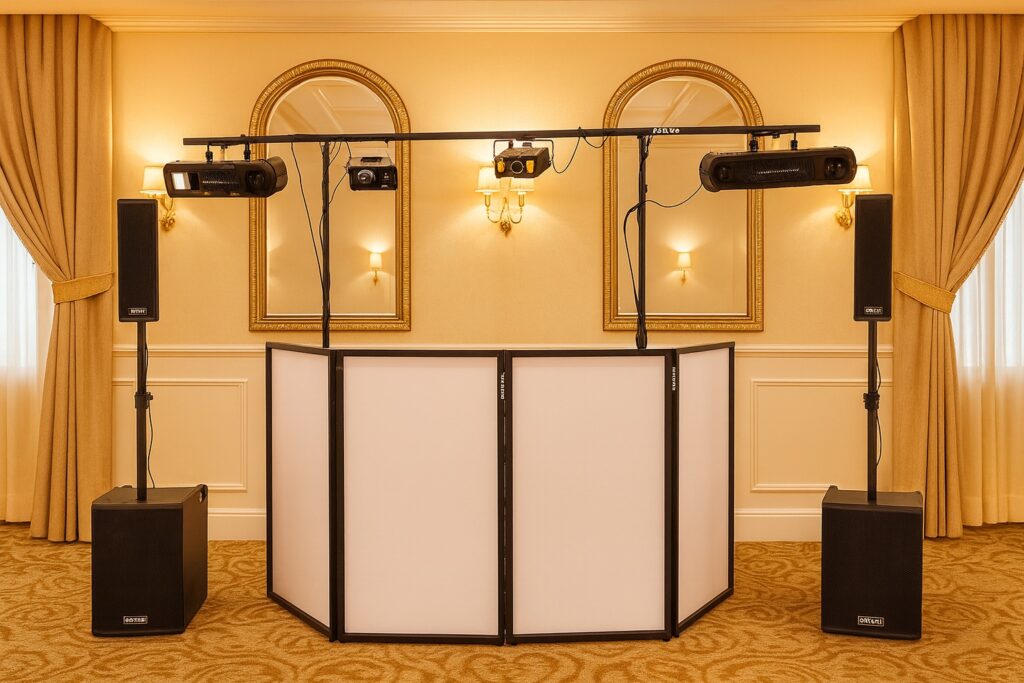
The word «booth» can refer either to the DJ’s equipment or to the cabinet or front panel surrounding it. Make it clear what is included. A white, black, illuminated or more decorative front panel changes the look of the setup and takes up space that needs to be allowed for.
Ask for a real-life photo of the proposed option. It’s important to see how it will look with your décor, but also where the wiring is concealed, whether it leaves enough space to work, and whether it can be fitted using the existing access points.

Party and mood lighting
Dance lights and those used to illuminate walls or corners serve different purposes. You might want a dance floor with dynamic lighting whilst keeping the rest of the room in a more subdued light. Alternatively, you might prefer a more understated look throughout the entire celebration.
If you’re offered smoke or other effects, check with the venue to see if they’re allowed. They shouldn’t turn up unannounced, and you shouldn’t assume that every venue allows them. Choosing a few well-thought-out elements usually works better than filling the room with things you haven’t asked for.
The open bar does not automatically cover the entire wedding
This is one of the points that really needs to be sorted out. A mobile DJ set-up in the ballroom alone won’t be enough to cover a ceremony in the garden, a cocktail reception on another terrace and speeches during dinner.
Imagine you’re getting married outdoors, having your cocktail reception in a courtyard and ending up dancing indoors. If the equipment needs to be moved from one area to another, you’ll need to allow time for this, ensure there’s access, and have someone on hand to do it. If the activities overlap, you may need to have more than one system set up.
Put it in writing which areas are covered and from what time each one will be ready. If you’d like to look back at those moments in more detail, the guide on sound for the ceremony, the drinks reception and the party will help you identify your requirements for each area.
Microphones also deserve a section of their own. A microphone positioned next to the podium is not the same as a solution designed for a celebrant and several readers standing some distance away from it. Make sure you know where each person will be speaking and who will be in charge of the sound.
A layout to suit the space you actually have
Interior: layout, acoustics and communal living
Check that the location of the photo booth is suitable for the venue. It must allow for work to be carried out, access to the dance floor, and coexist with exits, foot traffic and service. It is not a good idea to choose a corner simply because it looks good in a photo if the equipment then hinders guests’ movement.
Some rooms are very echoey; others have partitions or areas that are difficult to cover. A professional should be able to assess the layout and recommend the best setup. If there is already a system in place at the venue, you need to check its connections, its condition, who operates it and whether it is suitable for dancing.
Outdoors: protection and site conditions
A terrace or garden needs to be prepared for sun, rain, wind and a suitable power supply. The protection of the installation must be agreed in advance with the venue and the professionals carrying out the installation. A practical indoor alternative also requires a suitable location and time to set up – it’s not just a matter of saying, «If it rains, we’ll go inside».
Please confirm the timetable, noise restrictions and the specific conditions of the venue. There is no single volume level that applies to all venues. The set-up and the event must be adapted to what your venue allows.
Costs that may not be included in the initial price
Two packages with the same number of hours may have different total costs because one involves more logistics or covers several areas. Take a look at the breakdown before deciding that one is expensive or the other is a bargain.
- Transport and travel. Distance, parking, access and any accommodation requirements.
- Loading and assembly. Stairs, distance from the unloading point, access windows or installation well in advance.
- Waiting time. A long break between the team’s preparations and the performance.
- Another space with a sound system. A ceremony, a cocktail reception or an area that needs to be in use at the same time.
- Additional material. Microphones, decorative lighting or a different booth to the one provided.
- Technical staff. When performances, microphones or production require dedicated attention.
- Extension of the festival. Cost, the person authorised to make the decision, and availability during the venue’s opening hours.
Ask for the total including tax and the terms and conditions for booking, changes or cancellations. If you need a guide to understanding market rates, you can check What factors influence a DJ’s fee in Madrid?. Then compare quotes for the same scope of work: no general price range can replace a quote tailored to your date and venue.
What to ask about incidents and changes to the timetable
«We have a professional team» does not explain what happens if a sound system breaks down or if the reception is delayed. Ask how incidents are handled, what contingency plans are in place and who makes decisions when schedules change.
The backup solution must be proportionate to the event and the set-up. There is no need to request a complete duplicate of every piece of equipment without good reason, but you do need a specific solution covering the key aspects of the service. At a wedding, continuity and coordination are part of the value you are paying for.
You should also agree on a point of contact for the reception. If different people give the DJ conflicting instructions, it becomes more difficult to know when to start the dancing or to wait for the bride and groom to arrive. The person in charge of the organisation must be able to communicate a clear decision.
A proposal that suits your wedding
To start with, please send us the date, venue, approximate number of guests, the different areas and the timetable. Let us know what sort of style you’re after and which moments you’d like us to capture. A floor plan or some photos of the venue are much more helpful than simply asking for «a good mobile disco».
In Aleea’s wedding service We set up various types of sound systems and can advise you on what would work best for your event. Sometimes a compact, elegant setup is best; at other times, it’s better to boost the sound or split the equipment between different areas. The idea is that every element has a specific purpose and that you know exactly what you’re booking.
In the gallery of performances and productions You can look at examples to explain the style you like. The final proposal is tailored to the location and intended use: you don’t choose a cabin just because of a photograph, nor an installation just because of its power rating.
If you’re still deciding on the music for each part, start by planning the order of the proceedings. Choosing the programme is easier once you know where you want to have a reading, hold a chat during the cocktail reception and get the dance floor going.
Some questions that often come up
Does a mobile disco always include a DJ?
The term usually refers to a service featuring a DJ and a mobile sound system, but the scope can vary. Make sure you confirm exactly who will be performing, for how many hours, and what music is included in the package.
Does it include music for the ceremony and the drinks reception?
Not necessarily. An open bar package may only cover the party itself. Please specify the events, venues and set-up times so we can determine whether any additional equipment is required.
Do you need a large marquee for a wedding with lots of guests?
The size of the unit does not determine the sound coverage. The audio installation, the workspace and the visual presence of the booth are assessed separately.
Can we use the equipment on the estate?
Yes, provided it is found to be fit for its intended purpose and the connections and responsibilities are agreed upon. A background music system is not always suitable for a party.
What happens if we want to extend the open bar?
Agree in advance on the amount, who can authorise it and the conditions of availability. The extension also depends on the venue’s opening hours and restrictions.
What information do I need to request a quote?
Date, venue, approximate number of guests, timings and the areas you wish to cover. Please include any requirements for microphones, musicians and the visual aspects of the production to clarify the scope.